
Self-Compassion: The Skill We Mistake for Weakness


Laura walked out of the meeting replaying every second of it.
She had spoken too fast. Missed a point. Her voice felt shaky when she responded to a question. And worst of all—she noticed it.
By the time she reached her desk, the verdict was clear: “That was embarrassing. You should have been more prepared. What’s wrong with you?”
What Laura didn’t pause to notice was this: She had been carrying the workload of two people for weeks. She had slept poorly. She had gone into that meeting already overwhelmed.
But none of that made it into her inner dialogue.
Instead of context, she gave herself criticism. Instead of understanding, she chose judgment.
Now imagine this:
A colleague comes to Laura after the same meeting and says, “I feel like I completely messed that up. I was so nervous.”
Would Laura respond with: “Yes, you did. You should have done better.”?
Of course not.
She’d say something like: “Hey, you’ve had a lot on your plate. It makes sense. You handled it better than you think.”
Would you speak to a friend the way you speak to yourself?
What Self-Compassion Is (and Isn’t)
Self-compassion is often misunderstood.
It’s not about lowering standards or avoiding responsibility. It’s not self-pity. And it’s certainly not an excuse for inaction.
Self-compassion is the ability to acknowledge your experience honestly—without attacking yourself for it.
It sounds like:
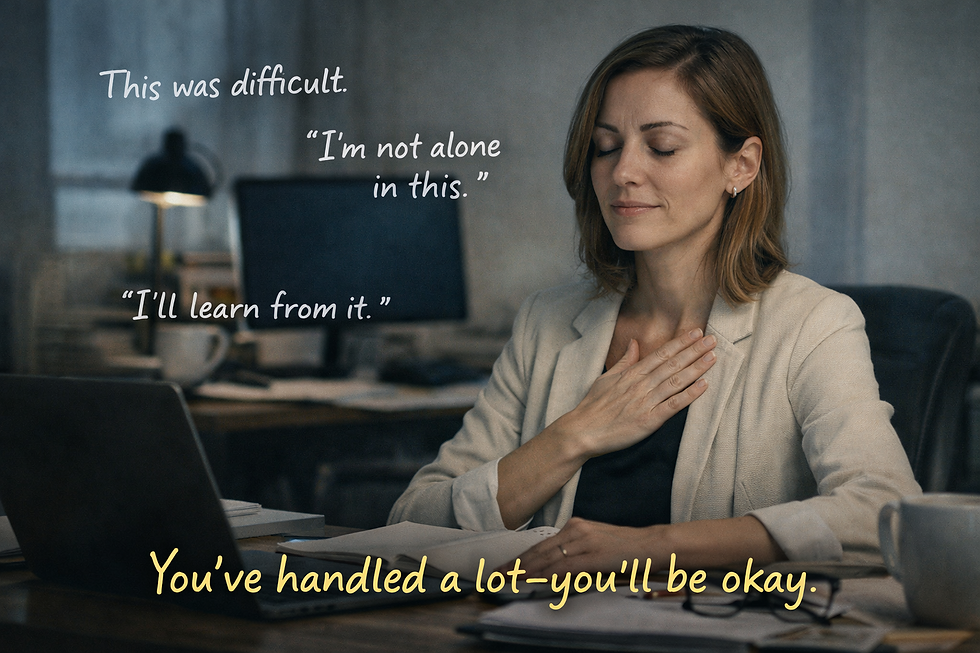
“This was hard.”
“I didn’t show up as I wanted—and I can learn from it.”
“Given everything, this makes sense.”
It allows both truth and kindness to coexist. Psychologists Christopher Germer and Kristin Neff describe self-compassion as having three core elements: treating yourself with kindness rather than judgment, recognizing that struggle is part of the shared human experience, and staying mindful of your emotions without becoming overwhelmed by them.
Because growth doesn’t come from harshness—it comes from clarity without fear.
The Psychology Behind It (Why It Matters)
From a psychological perspective, self-compassion doesn’t just feel better—it changes how our nervous system responds to stress.
Researchers suggest that self-compassion helps deactivate the brain’s threat system—the part responsible for defensiveness, anxiety, and heightened stress—and instead activates the caregiving system, which is linked to feelings of safety, connection, and emotional regulation (Gilbert & Proctor, 2006). In practical terms, this means your body shifts from “something is wrong” to “I can handle this.”
This shift is not only theoretical. Studies have shown that even brief self-compassion practices can lower levels of cortisol, the body’s primary stress hormone, while increasing heart rate variability—a key indicator of our ability to calm ourselves under pressure (Rockcliff et al., 2008; Porges, 2007).
In other words, self-compassion doesn’t remove stress—but it changes your capacity to respond to it.
A Gentle Shift
The next time you find yourself in a moment like Laura’s, pause.
Instead of asking: “What’s wrong with me?”
Try asking: “What do I need right now?”
You’ve probably heard about the importance of responding to the needs of children—or those of a partner or loved one. So why do we treat ourselves differently?
Science supports this, too. Research shows that people who practice self-compassion respond to setbacks in a fundamentally different way—they don’t spiral as deeply, they recover more quickly, and they approach challenges with greater clarity and perspective (Leary et al., 2007).
Don’t underestimate the question: “What do I need right now?” Pause—and answer it.
It might be clarity. It might be rest. It might simply be a gentler tone.
Know thyself. Not to judge—but to understand.
Be mindful enough to notice. Kind enough to respond.
Ready to master language with creativity and inspiration?
Book your first session with Neringa—let’s get started! CHECK MY OPTIONS
Further research
Germer & Neff, Self-Compassion in Clinical Practice. 2013 Wiley Periodicals, Inc. J. Clin. Psychol: In Session 69:856–867, 2013.
Picture: AI generated


Komentarai